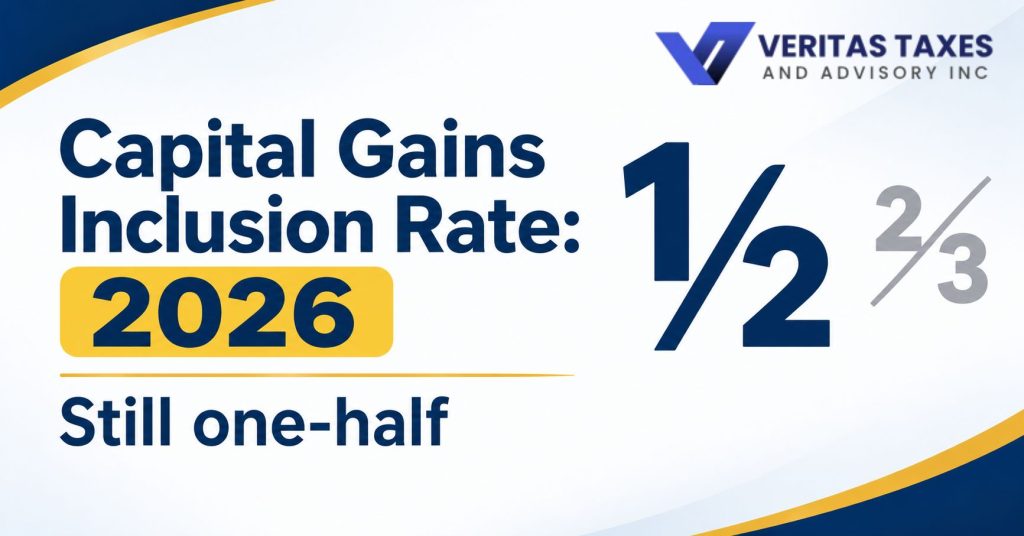
If you have spent the past two years bracing for a higher capital gains inclusion rate, you are not alone. The capital gains inclusion rate in Canada is one of the most misunderstood figures in the tax system right now, largely because the government spent nearly a year proposing a change that never took effect. As you head into year-end 2026 tax planning, it is worth setting the record straight for anyone selling a business, a rental property, or a portfolio of investments.
The short version: the one-half inclusion rate is still the law, and it has never stopped being the law. But the path to that conclusion involved a budget proposal, a deferral, and finally a cancellation, and many taxpayers are still planning around a rate that was never actually enacted.
What the 2024 Federal Budget Proposed
Budget 2024 proposed raising the capital gains inclusion rate from one-half to two-thirds. For individuals, the higher rate would have applied only to gains above $250,000 in a calendar year. For corporations and most trusts, it would have applied to every dollar of capital gain, with no threshold at all. The government set an effective date of June 25, 2024, and the Canada Revenue Agency began administering the higher rate that fall based on a Notice of Ways and Means Motion, even though no bill had been passed.
That administrative choice caused real confusion. Accountants filed returns using forms built around the two-thirds rate, corporations adjusted tax provisions, and many business owners accelerated sales to lock in the lower rate before the deadline. Then the legislative process stalled.
The Capital Gains Inclusion Rate: Deferral, Cancellation, and Current Status
On January 31, 2025, the Finance Minister announced the increase would be deferred to January 1, 2026, rather than taking effect retroactively to June 2024. The CRA reverted its forms and guidance to the enacted one-half rate for anything disposed of before 2026, and it extended late-filing and interest relief to individual and trust filers caught in the back-and-forth.
Then, on March 21, 2025, Prime Minister Mark Carney confirmed the government would not proceed with the increase at all. The proposal was shelved outright, not pushed back again. The CRA has since reassessed filers who reported gains at the higher rate, and the one-half rate has applied without interruption through 2025 and into 2026, with no legislation pending to revisit it.
That means, for 2026, individuals, corporations, and trusts all continue to include only 50 per cent of a realized capital gain in income, regardless of the size of the gain or who realized it. There is no $250,000 annual threshold to track and no higher corporate rate to model. If your financial plan, your buy-sell agreement, or your estate freeze was built around a two-thirds rate that might still arrive, it is time to revisit those assumptions.
What Did Survive From the 2024 Budget
Not everything from the original package disappeared. The increase to the Lifetime Capital Gains Exemption did go ahead. The LCGE rose to $1.25 million for dispositions of qualified small business corporation shares and qualified farm or fishing property on or after June 25, 2024, and indexation to inflation resumed in 2026, putting the current limit at approximately $1,275,000. Business owners planning a sale of shares, or a succession to the next generation, should confirm the exact indexed figure for the year of disposition rather than relying on the flat $1.25 million number many online calculators still show.
The proposed Canadian Entrepreneurs’ Incentive, which would have reduced the inclusion rate to one-third on up to $2 million of eligible gains for qualifying entrepreneurs, was not as fortunate. It was cancelled along with the rate increase and will not be introduced in its proposed form.
Planning Implications for 2026
For most clients, the message is reassuring: capital gains planning and business tax planning for 2026 can proceed using the familiar one-half inclusion rate, without reserving for a higher rate that might apply retroactively. That said, a few areas still deserve attention before year-end.
Anyone who sold property, shares, or investments in 2024 or 2025 assuming a higher rate applied, or who deferred a sale specifically to avoid it, should revisit that decision with current numbers, ideally with a personal tax accountant. A sale delayed to dodge a two-thirds rate that never arrived may have cost more in lost opportunity than it saved in tax.
Owner-managers nearing retirement or a sale should also confirm, with a corporate tax accountant, how much of their qualifying LCGE room remains available, since prior claims, associated corporation rules, and the annual indexed increase can all shift the number from year to year. For those with cross-border exposure, a Canadian capital gain taxed at one-half inclusion still needs to be reconciled against US reporting obligations and foreign tax credit calculations, which follow their own rules regardless of Canada’s domestic rate.
Key Takeaways
The capital gains inclusion rate in Canada remains one-half for 2026, for individuals, corporations, and trusts alike. The two-thirds rate proposed in 2024 was deferred once and then formally cancelled in March 2025, and no new increase is currently before Parliament. The Lifetime Capital Gains Exemption did increase and is now indexed, sitting at roughly $1,275,000 for 2026, while the proposed Canadian Entrepreneurs’ Incentive did not survive.
Tax proposals that generate this much news coverage can linger in client memory long after they are resolved, which makes year-end a good time to confirm which rules actually apply to your situation. If you are planning a sale of business shares, investment property, or a significant portfolio position before the end of 2026, a short conversation with tax accountants now can confirm your exposure and remaining exemption room before you sign anything. Sandeep Puri, CPA, works with business owners, investors, and cross-border families throughout the Woodbridge area and beyond, and is happy to walk through how these rules apply to your numbers.