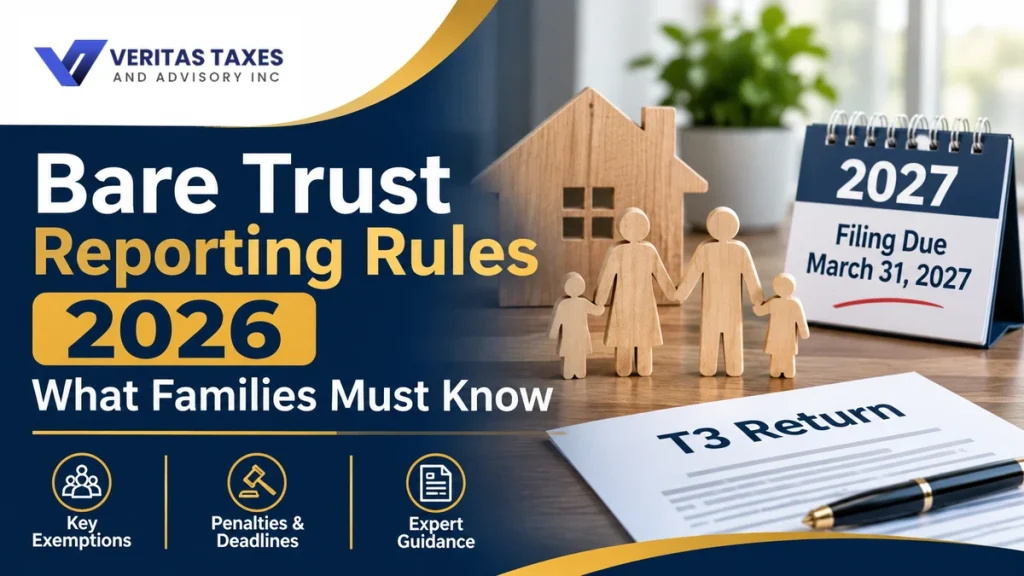
If your family holds property in a joint account, an “in trust for” account, or has an adult child named on a parent’s title, new bare trust reporting rules will change what the Canada Revenue Agency expects from you. Bill C-15 received Royal Assent in March 2026, and the revised bare trust reporting rules now apply to taxation years ending after December 30, 2026. Many arrangements long treated as informal family matters will need a T3 return and a beneficial ownership schedule filed with the CRA, with returns due by March 31, 2027. Families seeking professional guidance on these requirements can explore our tax and accounting services for individuals and businesses.
For cross-border families, blended households, and anyone doing estate planning in Ontario, this is not a minor compliance footnote. It touches some of the most common planning tools families use: adding a child to a cottage title, parents holding funds “in trust for” a grandchild, and nominee arrangements used in real estate deals.
What Changed: Bill C-15 and the New Rules
Under the previous framework, the CRA repeatedly deferred bare trust filing obligations for 2023 through 2025, after widespread confusion and backlash from accountants and taxpayers. Bill C-15, the Budget Implementation Act, 2025, No. 1, formally repealed the earlier rule and replaced it with a narrower, better-defined bare trust reporting regime.
The practical result: no bare trust filings were required for 2023 through 2025, barring a direct CRA request. The new rules take effect for taxation years ending after December 30, 2026 — calendar-year arrangements face their first filing obligation for 2026, with returns due 90 days after year-end.
Which Arrangements Are Now Caught
The revised bare trust reporting rules are more targeted than the original 2023 version, but several everyday family arrangements remain squarely inside them.
A parent who keeps an adult child on title to a rental property or a cottage, while the parent remains the true economic owner, is generally a reportable bare trust. The same applies to nominee corporations holding real estate for a related party, and to bare trustees used in joint ventures or development projects among unrelated parties.
Joint accounts are more nuanced. A joint account between spouses is typically exempt because both parties are legal and beneficial owners. A joint account added for convenience — say, an adult child added to a parent’s bank account so bills can be paid — depends on the dollar value involved and on family relationships, which brings us to the exemptions.
“In trust for” accounts set up for grandchildren or minor beneficiaries need their own analysis. Whether such an account is treated as a true bare trust or an informal trust affects whether it falls under the new bare trust reporting rules, so review these arrangements individually rather than assuming they’re exempt.
Key Exemptions Worth Understanding
Not every informal arrangement will need to file. The legislation preserves several carve-outs that matter for ordinary families.
Arrangements holding assets worth $50,000 or less throughout the year are generally exempt, as are trusts that existed for less than three months. There is also a family exemption covering individual trustees and beneficiaries who are all related to one another, holding qualifying low-risk assets worth $250,000 or less throughout the year.
Mirror-ownership situations — where the people on legal title are the same people who are the beneficial owners — are excluded, as is a parent remaining on title to a principal residence they actually live in. Spousal real property, partnership property where a T5013 is already filed, and court-ordered arrangements round out the main exceptions.
One detail trips people up: these dollar thresholds apply throughout the entire calendar year. An account that dips below $50,000 for eleven months but crosses above it even briefly can lose its exemption, so families near these thresholds should track balances carefully through 2026 rather than checking only at year-end.
Penalties for Missing the Deadline
The CRA’s penalty relief, which protected taxpayers through the 2023–2025 transition, does not extend to the 2026 taxation year. Ordinary late-filing penalties return to $25 per day, with a minimum of $100 and a maximum of $2,500 per return — and these apply even where no tax is owing, because a bare trust return is purely an information filing.
Where the CRA finds the failure to file was knowing or grossly negligent, including ignoring a formal demand to file, the penalty rises to the greater of $2,500 or 5% of the trust’s highest fair market value during the year — a calculation that can produce a meaningful number quickly for a family cottage or investment property.
What Families and Executors Should Do Now
With more than a year before the first filings are due, 2026 is the right time to get ahead of the bare trust reporting rules rather than scrambling in early 2027.
Start by inventorying arrangements: title searches on real estate, old joint account agreements, and any “in trust for” accounts set up for children or grandchildren. For accounts or properties near the $50,000 or $250,000 thresholds, begin tracking values now so you know whether an exemption applies for the full year. Trust account numbers and beneficial ownership details can take months to assemble, so earlier is better than later.
This is also a natural moment to revisit whether old bare trust arrangements still serve their original purpose. An adult child added to a parent’s title ten years ago for probate planning may no longer be the right tool — especially once the compliance burden and filing costs of a new reporting obligation are weighed against the benefit.
If your family has property held through joint ownership, informal trusts, or cross-border estate structures, our Woodbridge-based practice can review your specific arrangements against the new bare trust reporting rules and help you decide what, if anything, needs to change before the 2026 year-end. Reach out to schedule a review while there is still time to plan rather than react.
For families reviewing the wider tax implications of property ownership, a personal tax accountant can also help assess how these arrangements may affect individual tax reporting. Business owners and families with corporate or nominee ownership structures may benefit from guidance from a corporate tax accountant.
Veritas Taxes is a professional accounting firm providing tax and accounting services to individuals and businesses across Vaughan and the GTA.