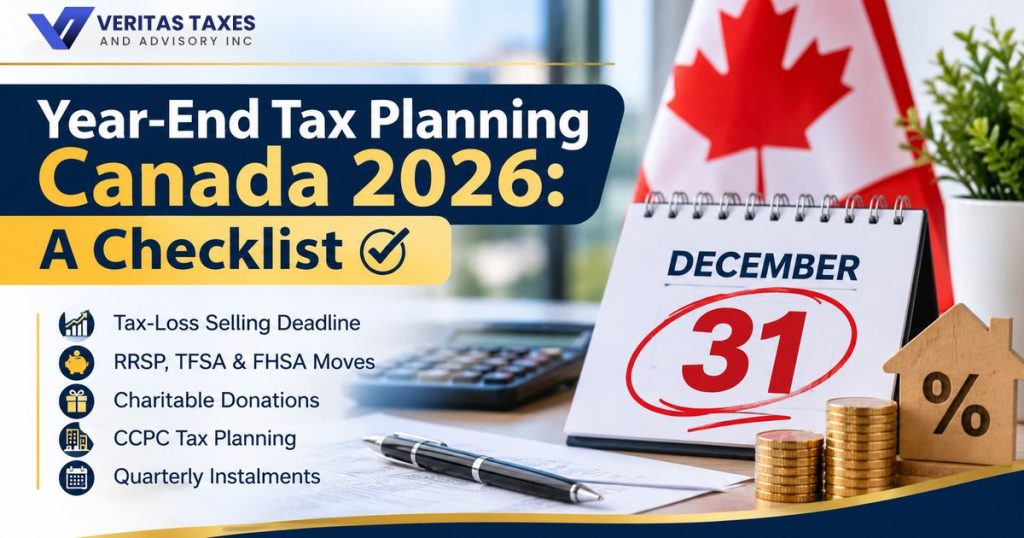
For most Canadians, December 31 is the hard deadline for the tax moves that actually matter to your 2026 return. Year-end tax planning in Canada for 2026 is not something to leave until the last week of the year — several of the most valuable deadlines fall earlier, and a few important dates have shifted because of how investment trades now settle. Whether you are an employee, a retiree, or the owner-manager of a Canadian-controlled private corporation (CCPC), a short review now can meaningfully change what you owe next spring.
Below is a practical rundown of the deadlines and strategies worth looking at before the calendar turns over, along with a few items that are easy to miss.
The December 30 Deadline for Tax-Loss Selling
If you hold non-registered investments that have dropped in value, selling them before year-end lets you realize a capital loss that can offset capital gains realized earlier in 2026, or be carried back three years or forward indefinitely. The catch is that what matters for tax purposes is the settlement date, not the day you place the trade.
Since May 2024, Canadian equities settle on a T+1 basis — one business day after the trade. For 2026, that makes Wednesday, December 30 the last trading day for a sale to settle inside the 2026 tax year, because the Toronto Stock Exchange is closed December 25 for Christmas and December 28 for Boxing Day observed. A trade placed on December 31 will not settle until January 4, 2027, pushing the loss into next year. Watch the superficial loss rule too: repurchasing the identical security within 30 days before or after the sale (in your own account, your spouse’s account, or an RRSP/TFSA) will disallow the loss.
RRSP, TFSA, and FHSA Moves Before December 31
RRSP contributions are the one major exception to the December 31 cutoff — you have until 60 days into the new year, so the RRSP deadline 2026 falls on Monday, March 1, 2027. The 2026 RRSP dollar limit is $33,810 (rising to $35,390 for 2027), subject to your earned-income-based room. If your spouse is 71 or younger, a spousal RRSP contribution made before year-end can still shift income to a lower-earning spouse for retirement.
TFSA room for 2026 stayed at $7,000, unchanged from 2025. If you plan a TFSA withdrawal regardless, doing it before December 31 rather than in January means the withdrawn room is added back on January 1, 2027 instead of January 1, 2028—a full year sooner.
First Home Savings Accounts (FHSAs) carry $8,000 of annual room. If you have not opened an FHSA yet but expect to buy a home eventually, opening the account before December 31 locks in 2026’s room even without an immediate deposit — unused room only carries forward once the account exists.
Charitable Donations and RESP Contributions
To claim a credit on your 2026 return, donations to a registered Canadian charity must be made by December 31, 2026. Combining several years of giving into one larger donation, or donating appreciated securities directly rather than cash, can both increase the after-tax benefit — donating securities in kind avoids capital gains tax on the appreciation entirely.
For families with young children, a Registered Education Savings Plan (RESP) contribution of at least $2,500 before December 31 attracts the 20% Canada Education Savings Grant, worth up to $500 for the year — or up to $1,000 if there is unused grant room carried forward from earlier years.
Year-End Tax Planning for CCPC Owner-Managers
Owner-managers of a CCPC have a second year-end to think about: the corporation’s own fiscal year-end, which does not have to be December 31 and also sets the filing deadline for your T2 corporation income tax return. Before that date closes, it is worth revisiting the salary-versus-dividend mix for the year as part of your business tax planning, since salary creates RRSP room and pensionable earnings that dividends do not. A bonus accrued at year-end can be deducted by the corporation in that fiscal year even though it is not paid until later, provided it is actually paid out within 180 days of the corporation’s year-end.
This is also the point to check whether a shareholder loan taken earlier in the year needs repayment before the corporation’s next year-end to avoid having the full amount added to personal income, and to confirm whether passive investment income inside the company is approaching the threshold that grinds down the small business deduction.
Quarterly Instalments Due December 15
If you pay income tax by quarterly instalments — common for the self-employed and retirees with significant investment income — the fourth and final 2026 instalment is due December 15. Missing it, or underpaying earlier instalments, can trigger daily-compounding instalment interest, so confirm your running total against CRA’s instalment reminder before the deadline passes.
Pulling It Together
None of these strategies works equally well for everyone, and the right combination depends on your income level, residency, whether you own a corporation, and what else changed for you in 2026 — including any measures from the November 5, 2026 federal budget that affect your particular situation. The common thread is timing: RRSP contributions aside, nearly everything on this list needs to happen by December 31, and tax-loss selling effectively needs to happen a day earlier than most people assume.
Good year-end tax planning is less about any single manoeuvre and more about reviewing investment accounts, registered plans, corporate structure, and charitable intentions together, rather than one at a time as deadlines arrive.
If you have not reviewed your 2026 tax position yet, now is a reasonable point to do it, whether on your own or through tax planning services — there is still enough runway to act on most of the items above before the window closes. A conversation with tax accountants in December is almost always more useful than one in April, when the only thing left to do is report what already happened.